Showing posts with label process. Show all posts

Sunday, 22 July 2012

Tea Stains

Here are the pictures of the results of the rose tea staining on the the stud clusters. As hoped there is a nice black rust ring round the clusters and also a nice layer of green on the studs themselves; from the coating of the metal I presume. 


Showing the black stains.


Close up of the clusters and the green coating that has appeared.


I am happy that more colours are being introduced into the work and would like to see more staining coming from the green coating - maybe some rubbings etc.

At the moment I am currently working on a plan for a workshop day with Sara, as we are just at the end of the experimenting stage. Re-worked has had to take a bit of a back seat, especially in the last few months as Sara is studying hard for her final Masters assessments, however we hope to get back on track quickly once it's ended. The works there - it's just not getting uploaded!! I hope to post the workshop plan this week with lots of basic workshop techniques!


Saturday, 14 April 2012

Bow: Affected.


The green staining of the bow reminds me of other natural states of disintegration and decomposition  - I think perhaps some other organic processes could be influenced and induced within our project work. More homework required!

Friday, 30 December 2011

Collar-ing


This was the winning mode of embellishment for me. Quite pleased with the progress of this collar, though I am unsure of how I will move it forward in terms of rusting or affecting the pearls as I do not want to 'attack' this piece with too harsh a process. As it is in the moment, (I am still stitching - those pearls are fiddly and require a teeny tiny needle!), I think the collar is very pretty and still rather delicate and I want this element to remain true as I continue to work on it.

Sunday, 13 November 2011

Collars


Some ideas I've been throwing around for the mens collars that Nicola sent me...
Apologies for the quality of the images - I haven't the best scanner in the world and I had to use photographs from my phone (note the yellowing collar second from the bottom is not so yellow in real life!)
I have been thinking mostly about composition, combinations of materials (though nothing too wild as I don't think that these pieces should be overcomplicated), weight, shape and scale...
I feel that it is important to put real thought into the process before I apply anything to any of the collars, particularly the white ones as I am unsure as to how well the starch will take any rusting. I want to get them right. Though it is tough to predict what an erratic process such as rusting will do!
More to follow...

Sunday, 23 October 2011

Parcel From Nicola

This again, is a late post. I am finding it rather frustrating that the day-to-day is getting in the way of our project so I have taken great advantage of a free evening to catch up; Nicola's final parcel has proven very exciting. I have been eager to experiment!

I was very pleased that Nicola included materials that I have no experience in working with at all as yet, for example the hematite beads and pearls. Both are typically associated with jewellery as opposed to textiles, so it will be interesting for me to apply my skills in reworking them. The ring blanks too, will be interesting for me to play with; having no concept of 'building' a ring from bands such as these, I am hoping that my novice will introduce a new (and successful?!) use for them.

Nicola also provided interesting textile items, such that I am more familiar and confident in working with, though I will say, have prompted me to more consideration of my methods;

Mens' collars: I like the idea of working with this more rigid, masculine shape as I feel that I have subconsciously approached the project thus far, with solely females in mind, favouring looser shapes and softer fabrics. It will  be very interesting to see how rust might 'move' against a heavily starched surface.  I am currently pondering how I might best embellish and/or print designs onto these. It will be a great task to work with these in contrast to the beautiful, and extremely feminine vintage lace collar that Nicola also included. Having received them both in the same parcel, I am now able to consider the real difference in treatment they will require if I am to get the most from them.

 Pink Basque: I agree with Nicola entirely in that, upon first receiving this item, it did not seem to fit within our colour scheme but in considering the direction of our project now, it is a welcome addition to our palette and has wide scope for use. I can see too, it being useful as an embellished garment or in being 'stripped back', using parts of it to form other pieces.

Pins: I love that they are gold! For the most part, any pins that I have worked with in rusting experiments before, have been silver. I expect that this will prove fruitful in expanding our colour palette. Nicola is right in her comments considering shape and draping - I think their size and weight alone will provide us with a strong collection of experiments.

Large Brass Chains: I can only dream of the beautiful prints we can create with these - I want to experiment ALOT with scale here, repeats and layers. I can envision these working well alongside other items (mostly chains!) that Nicola has sent me in the past.

I am off to edit photographs (these will be posted VERY soon) and develop some sketches. Nicola has provided me with a wealth of inspiration in this package and I want to do it justice. It is worth noting as well that I absolutely love the box that the parcel arrived in (the collar case); the fact that this is a purpose built casing being used to house its intended contents as well as 'new' found members is a lovely notion when considering the ethos of Reworked.

Saturday, 11 June 2011

Fabric Samples

In response to an earlier post in which Nicola and I discussed the possibility of producing rusty prints from rubbings, I have experimented with fabric swatches. Having begun with different weighted papers I found that too smooth or dry a surface encourages the rust to simply flake away. In order to make successful prints from the rust deposits a damp surface is needed. Samples previous to the paper below were dampened before rubbing but without prolonged contact with the damp surface, produced a weak print. The paper below was left overnight in damp conditions pressed against a pre-rusted paper clip chain.


 The results, though strong in colour, lack form.
I found that fabric treated with diluted vinegar and kept in the same conditions as the above, produced a far clearer print, with the fabric moulding to shape as it dried.


I think that making literal prints such as this could be an interesting way of making printed jewellery e.g. an emulative necklace or bracelet.

Powder Puffs - Post Rusting


As expected, these have been well dyed whilst rusitng despite my vigillance with exposure to oxygen being unpredictable in the continuation of the process. Again, I find these interesting as objects but am unsure as to how these would fit in with our final collection - perhaps not sophisticated enough an outcome. The sample in the bottom image rather reminds me of a mushroom! In the flesh, it's texture is pleasing - the embossing effect having been successful. I had planned to remove the staples but seeing the samples as they are now, I fear that removing them would leave them a bit lack luster - the embedded metal adds interest to the softness of the puffs.  

Saturday, 7 May 2011

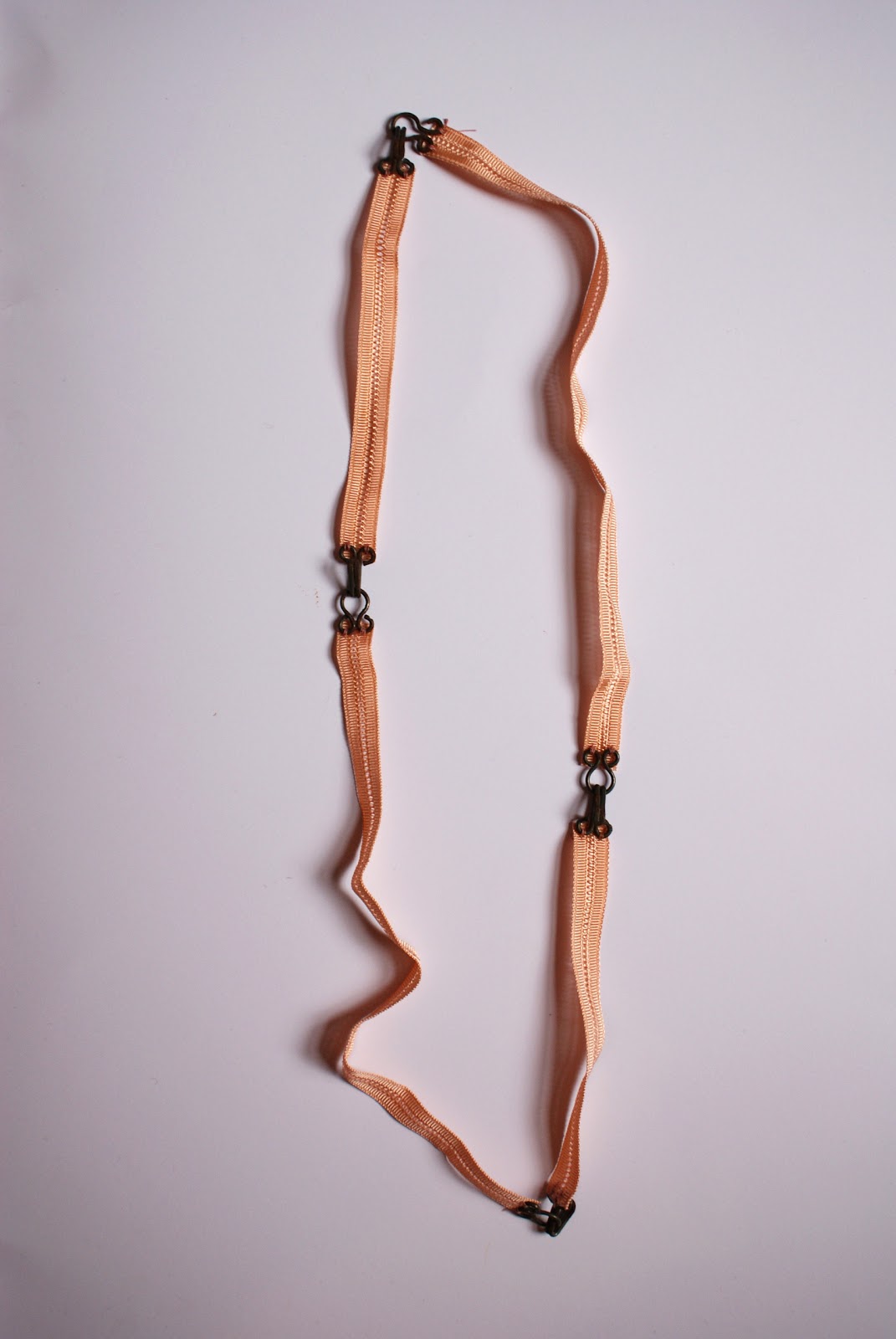
Experimenting with Ribbon

These are experiments based on Nicola's initial ideas when collecting the first lot of materials:


And compositional experiments with lengths of ribbon,silver chain and paper clips:


Both ideas combined:


I like the simplicity of these samples and the idea that each piece can be added to/have sections taken away. The pink ribbon allows for me to experiment with the softer spectrum of our materials and achieve a pretty and wearable outcome. I actually really like the silver against the pink. Being cleaner and reflective, it is a nice contrast against the grittier rusted pieces, whilst still sitting well within our collection. Although I will make similiar pieces to rust too.

Thursday, 10 March 2011

Initial Experiments #2


Handkerchief with tacs


Handkerchief "dyed" after tacs have rusted.


Close up of rusted tacs "dyeing" handkerchief material


Here are some experiments with tacs and handkerchiefs. I used a lot of tacs and the handkerchief is quite large so that gave me a good area to experiment on and see the results clearly. Again, this is tacked up outside, exposed to the elements and regular vinegar sprays from myself. I love the watery dye effect which suprised me as I was expecting harsher results. When I think of Re-worked, I imagine quite a "tough" collection with a distinctly "urban" feel so this soft feel may have to be explored further to see if it can be expanded on or discarded. It was again just nice to see a different process. It has made me think of the items used to create the organic prints (tacs and safety pins etc) as the jeweller in me sees them as items that could be used decoratively rather than a means to dyeing fabric. Again a concept to either work on or discard. 

Initial Experiments


Ticket attached to vintage jumper by safety pin.


Handkerchief square folded and attached to safety pin.


Numerous safety pins attached together creating "chains".


Safety pin chains hanging after being sprayed with vinegar.


While myself and Sara prepare for our initial swap of materials by gathering items both vintage and "every-day" (ie saftey pins, tacs, paper clips etc), I decided to start some basic experiments to familiarise myself with the materials and techniques we hope to use. Sara's final year project involved rusting staples stapled into fabric so I decided to try out the rusting process. Although rusting is something I'd like to either expand on or use in conjunction with other destructive processes I decided to learn about it as a basic foundation for Re-worked. I was inspired by a ticket I found attached to a vintage jumper by a safety pin which had obviously gone through the wash and had a nice crumbled texture. I started using plain handkerchiefs as a "beginners-introduction" to working with textiles and used vinegar, on Sara's suggestion, to rust the safety pins which then "dyes" the material. Sara also advised applying vinegar regularly to accelerate the process so they are currently tacked up to the outside of my shed - exposed to the elements and regular vinegar applications. I enjoyed this first basic experiment as it has already highlighted some ideas I would like to expand on and experiment with further.

Tuesday, 1 March 2011

Personal Brief

To begin this project myself & Sara wanted to take time to state what we wanted to achieve personally from Re-worked. Re-worked came about after the realisation that both our final year projects at university had used vintage materials in different ways and that, while I had experimented with textiles and textile techniques (e.g. flocking) which involved trips to the textile department, Sara had used the process of rusting on non-precious metals which led her to the jewellery workshop. Both of us had only begun to scratch the surface of each others specialism and felt that, by using each others knowledge to create and experiment (a luxury that was not possible in our final year), we could personally grow and develop while creating new work. For me Re-worked is especially exciting for two aspects: "organic print" and "destructive processes". I find the process of making jewellery very frustrating and demanding and feel I am constantly battling with small delicate objects, fighting them into place and labouring to get them to a gleaming end product. With that in mind "destructive processes" appeals to me for the relief of freely burning, rusting, and generally destroying(!), processes that never occur in my personal work. I love the idea of having the time and, with great gratitude, the funding to play with new ideas and knowledge and just have fun with the design process. By documenting the process through the blog we are stepping back from sketchbooks and allowing for outside critiques and quick discussion between ourselves as living in different cities makes it harder to be up-to-date with each others thought process. I like to think the idea of working this way is quite unique and we will hopefully produce like-wise results. The idea of "organic print" just fascinates me as there are so many possibilities. The idea of creating marks was, again, something I briefly touched upon in my final year project so I am looking forward to expanding on this concept with more knowledge of textile processes. Hopefully Re-worked will provide me with a good general knowledge of working with textiles, build on my confidence and expertise with metals by teaching Sara what I know, produce a fantastic collection that showcases the power of collaborations, inspires others to experiment in other disciplines and allows me to personally grow and develop through the experience.

Tuesday, 22 February 2011

"Re-worked"


"Re-worked will highlight the notion of preciousness in modern materials by examining the process of re-adapting vintage materials in making marks (permanent and impermanent) with precious and non-precious metals and destructive processes."


A collaboration between Sara Nevay & Nicola Reed, "Re-worked" will examine the process of reworked and reused vintage materials and how destructive processes can be used as organic "prints" can be used to highlight the idea of preciousness in modern materials. We aim to combine disciplines which will, as we adapt to working independently of University, arm us with further knowledge and skills as each of us plan to enlist techniques and materials traditionally associated with each other's specialism; we each touched upon this in our final year projects shown at the Duncan of Jordanstone Degree Show 2010. We plan, too, to explore the process of working between two cities, Sara based in Dundee and Nicola, Inverness, strengthening the craft links Dundee has with its graduates. 

Our project aims to work constructively with the nature of our chosen materials and processes, allowing us to explore in depth the growth of our collaboration and chart our personal progress as new designers chronologically. 

The project will take place by posting designs, as well as swapping reworked materials at different stages to see how they can be incorporated effectively into designs and can be used for their mark-making potential. Posting will act as markers in time of the deconstructive process, allow for regular revision of our work and growth of our designs and ideas as they are realised, and test the strength of our reworked samples as they are exposed to our design processes.